Cranberry Salsa: The Most Brilliantly Unexpected Condiment That Steals Every Holiday Table
Introduction: Why Cranberry Salsa Is the Most Wonderfully Surprising Thing You Will Bring to Any Holiday Gathering
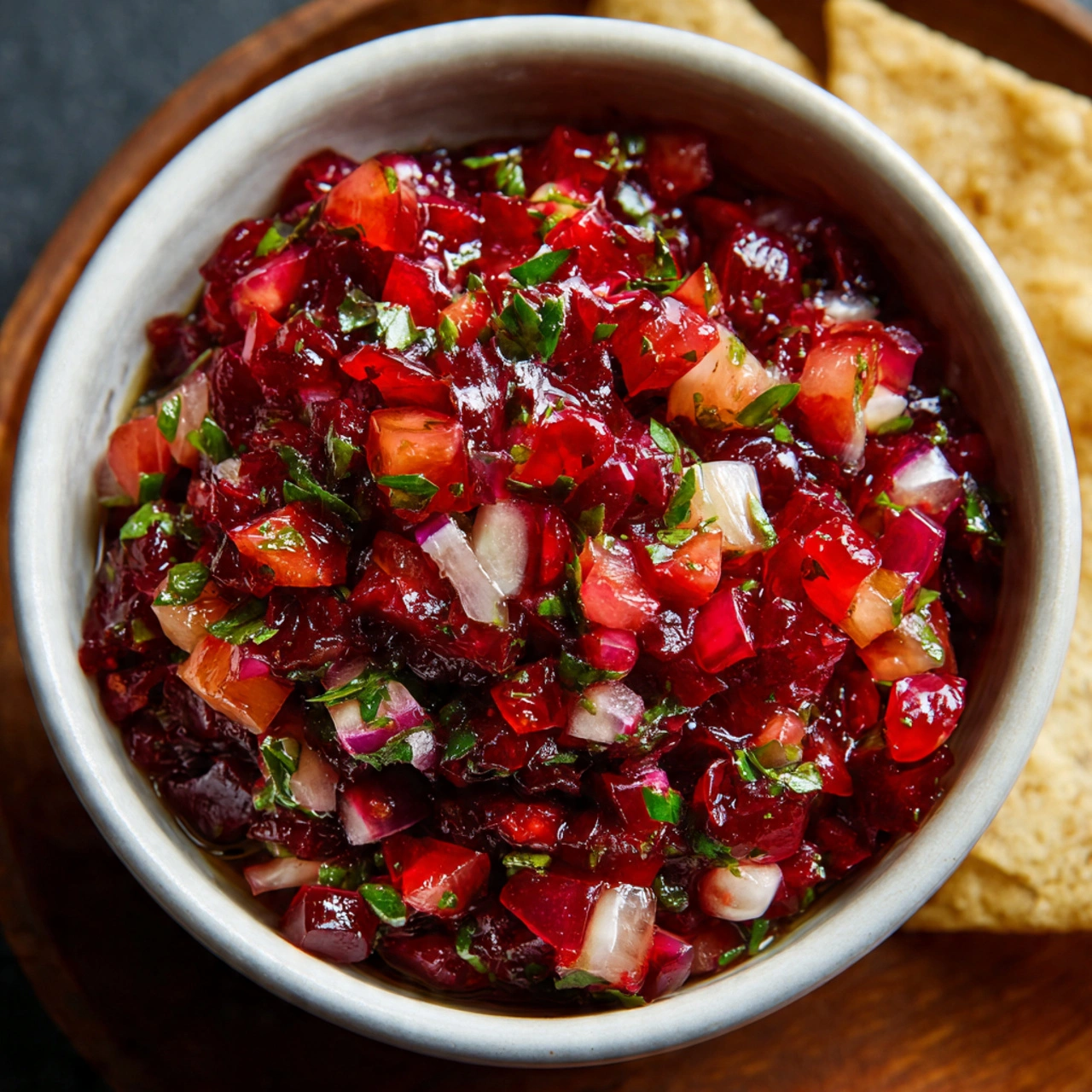
Cranberry salsa is the recipe that makes people stop mid-conversation, reach for another cracker, and immediately ask what they are eating. It is one of those dishes that sounds almost too unusual to be excellent — cranberries and salsa seem like an unlikely pairing on paper, and then you taste it and wonder immediately why you have never made it before. The combination of fresh tart cranberries, bright citrus, spicy jalapeño, sweet honey, and fragrant cilantro creates something that is simultaneously familiar and completely surprising — a condiment that behaves like a salsa and tastes like a celebration.
What makes cranberry salsa particularly brilliant as a holiday recipe is its versatility and its ability to occupy a completely different flavour space from everything else typically on the table. At a Thanksgiving or Christmas gathering where most of the food is warm, rich, fatty, and deeply savoury, a bowl of cranberry salsa arrives like a breath of cold fresh air — bright, acidic, slightly sweet, and genuinely spicy — and it makes everything around it taste better by contrast. It is the condiment that cuts through the richness of a cheese board, that lifts a turkey sandwich into something genuinely exciting, and that disappears faster than any other dish on the appetiser table.
I have been making this recipe for holiday gatherings for years, and every single time it generates more conversation and more recipe requests than anything else I bring. The reaction is always the same — mild scepticism followed by one taste followed by enthusiastic conversion. People who think they do not like cranberries change their minds. People who are devoted to traditional cranberry sauce start reconsidering. It is that kind of recipe.
This guide gives you everything — the complete ingredient list with the reasoning behind each choice, the step-by-step technique, the pro tips that elevate this from good to genuinely memorable, the mistakes that are easy to avoid, storage and serving suggestions for every occasion, a complete FAQ, and a full nutrition breakdown.
What Makes Cranberry Salsa Different from Cranberry Sauce
Before we get into the recipe, it is worth understanding what makes cranberry salsa fundamentally different from cranberry sauce and why that difference matters for how you use it and who it appeals to.
Traditional cranberry sauce — whether jellied from a can or homemade — is cooked, sweet, and jammy. It has a uniform texture, a one-note sweetness that most people find works specifically as a counterpoint to turkey, and a flavour profile that does not extend much beyond the holiday table context it was designed for. Many people who say they do not like cranberry sauce are really saying they do not like cooked, sweet, one-dimensional cranberry preparations.
Cranberry salsa is raw, fresh, textured, balanced between sweet and tart and spicy and acidic, and genuinely versatile. It takes the same cranberry tartness but frames it within a completely different flavour architecture — one that is more aligned with the brightness and complexity of a great fresh salsa than with the jammy sweetness of a traditional sauce. The result is a preparation that appeals to people who would never voluntarily eat cranberry sauce, works in contexts far beyond the holiday dinner table, and has a vibrancy and freshness that cooked cranberry preparations simply cannot achieve.
Ingredients
For the Cranberry Salsa Base
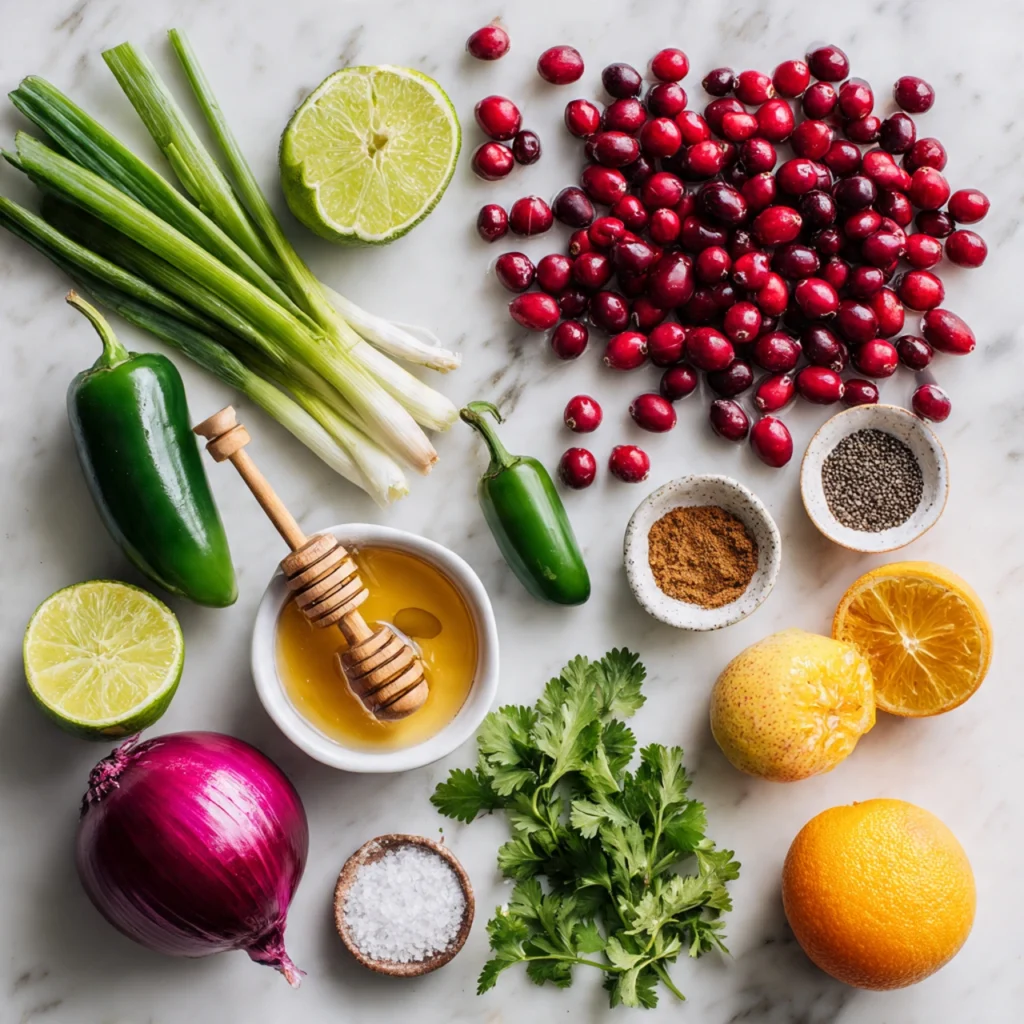
- 340g (12 oz) fresh cranberries — one standard bag, rinsed and picked over
- 1 jalapeño pepper, seeds removed for medium heat or seeds included for hot (adjust to preference)
- 1 serrano pepper, optional — adds extra heat and a slightly different spice character
- 3 green onions (scallions), thinly sliced — white and light green parts
- ½ medium red onion, very finely diced
- 1 large bunch fresh cilantro — approximately ½ cup packed, roughly chopped
- Zest of 1 large lime
- 3 tablespoons fresh lime juice (approximately 2 limes)
- 3 tablespoons honey or agave nectar — adjust to taste based on cranberry tartness
- 1 teaspoon fine sea salt
- ¼ teaspoon freshly cracked black pepper
For Optional Additions and Variations
- 1 teaspoon fresh ginger, finely grated — adds warmth and complexity
- ¼ teaspoon ground cumin — adds a subtle earthy note
- 2 tablespoons fresh orange juice — adds a different citrus dimension
- Zest of ½ orange — amplifies the citrus brightness
- 1 small clove garlic, very finely minced — adds savouriness (use sparingly)
- ¼ cup finely diced red bell pepper — adds sweetness and colour contrast
For the Classic Cream Cheese Serving (Optional but Extremely Popular)
- 225g (8 oz) block full-fat cream cheese, softened to room temperature
- Extra cranberry salsa spooned generously over the top
- Crackers, crostini, or pita chips for serving
Step-by-Step Instructions
Step 1: Prepare and Sort the Cranberries
Rinse the fresh cranberries thoroughly under cold running water in a fine mesh sieve. Pick through them and discard any that are soft, shrivelled, or discoloured — you want only firm, plump, deeply coloured cranberries for this recipe. Soft or overripe cranberries will produce a mushy texture rather than the clean, slightly chunky texture that makes a great cranberry salsa. Pat them dry with paper towels or shake the sieve vigorously to remove excess water — excess moisture dilutes the salsa and makes it watery rather than vibrant and concentrated.

Step 2: Pulse the Cranberries in a Food Processor
Place the sorted, dried cranberries in the bowl of a food processor. Pulse in short bursts — three to five pulses of about one second each — until the cranberries are roughly chopped into irregular pieces. You are looking for a chunky, textured result where most pieces are roughly quarter-sized, not a smooth puree. The texture is one of the defining qualities of a great cranberry salsa — too coarse and it is difficult to eat on a cracker, too fine and it loses the fresh cranberry character and becomes something closer to a relish. Stop and check the texture after each pulse. If you do not have a food processor, a sharp chef’s knife and a cutting board work beautifully — roughly chop the cranberries by hand into small irregular pieces.

Step 3: Prepare the Aromatics
While the pulsed cranberries sit in the food processor bowl, prepare the remaining ingredients. Remove the seeds and white membrane from the jalapeño — the membrane contains most of the capsaicin and removing it gives you jalapeño flavour with controlled heat. Finely dice the jalapeño flesh into pieces no larger than ¼ inch. If using a serrano, treat it the same way. Finely dice the red onion into pieces similar in size to the jalapeño — small and even so they distribute throughout the salsa rather than creating large concentrated pockets of raw onion flavour.
Zest the lime before juicing it — it is nearly impossible to zest a juiced lime, and the zest adds an intensely aromatic citrus note that the juice alone cannot provide. Roll the lime firmly on the counter before cutting to help release the juice.

Step 4: Combine All Ingredients
Transfer the pulsed cranberries from the food processor to a large mixing bowl. Add the finely diced jalapeño, diced red onion, sliced green onions, and roughly chopped cilantro. Add the lime zest and lime juice, honey, fine sea salt, and black pepper. If using any optional additions — grated ginger, ground cumin, orange juice, or orange zest — add them now. Stir everything together with a wide spoon or spatula until thoroughly combined and all the ingredients are evenly distributed throughout the mixture.

Step 5: Taste and Adjust
This is the most important step in the entire recipe and cannot be skipped. Taste the cranberry salsa and evaluate each flavour element separately. Cranberries vary significantly in tartness depending on the brand and the time of season — some batches are intensely tart and need more honey, others are milder and need less. The salt balance affects the perception of all other flavours — under-salted salsa tastes flat and dull regardless of how well-balanced the other elements are. The heat level from the jalapeño will intensify slightly as the salsa sits, so if it seems right immediately after making it will be slightly spicier after chilling. Adjust honey for sweetness, lime juice for acidity, salt for overall flavour depth, and jalapeño — add more finely minced fresh jalapeño if you want more heat at this stage.

Step 6: Chill and Rest
Cover the bowl with plastic wrap pressed against the surface of the salsa, or transfer to an airtight container, and refrigerate for a minimum of 30 minutes before serving. This resting time is when cranberry salsa goes from a collection of combined ingredients to a cohesive, unified condiment. The honey dissolves completely into the lime juice, the salt draws a small amount of moisture from the cranberries and other vegetables which thins the consistency slightly to the perfect texture, the heat from the jalapeño begins to permeate the surrounding ingredients, and the flavours begin to speak to each other in a way they simply do not immediately after combining. One hour of resting is better than thirty minutes. Two hours is better still.

Pro Tips for the Perfect Cranberry Salsa
Use Fresh Cranberries Not Frozen for Best Texture
Fresh cranberries produce a cleaner, firmer texture with better moisture control. Frozen cranberries, when thawed, release a significant amount of water that can make the salsa watery and diluted. If fresh cranberries are unavailable, frozen can be used — thaw them completely, drain thoroughly in a colander for at least 30 minutes, and pat dry with paper towels before processing. Expect a slightly softer, wetter result than with fresh.
Pulse, Never Process
The food processor technique for cranberry salsa is about controlled pulsing, not continuous processing. Three to five one-second pulses give you the ideal rough chop. Running the processor continuously for even five seconds will take you from rough chop to almost-puree. Once the cranberries are over-processed, the texture cannot be recovered. Pulse conservatively and check frequently.
Balance the Sweetness to Your Cranberries
Honey quantity in this recipe is a range rather than a fixed amount because cranberry tartness varies. Start with two tablespoons of honey, combine everything, taste, and add more incrementally until the tartness and sweetness are in the balance you prefer. The salsa should be noticeably tart — that tartness is what makes it refreshing and what makes it work as a contrast element to rich foods — but the honey should take the edge off the raw sharpness of the fresh cranberries.
The Zest Is As Important As the Juice
Lime zest contains the essential oils from the lime skin — volatile aromatic compounds that contribute an intensely fragrant citrus character that juice alone completely lacks. Many cranberry salsa recipes use only lime juice. Adding the zest as well elevates the citrus dimension from one-dimensional acid to a genuinely aromatic, fragrant brightness. Use a fine microplane grater and grate only the green outer layer — the white pith beneath is bitter.
Make It the Day Before
Cranberry salsa genuinely improves overnight. The twenty-four hour resting period allows every flavour to fully develop and integrate — the honey completely dissolves, the salt penetrates the cranberry flesh slightly, the jalapeño heat distributes evenly throughout, and the lime zest perfumes the entire mixture. A same-day cranberry salsa is good. A next-day cranberry salsa is magnificent. If you are making this for a Thanksgiving or Christmas gathering, making it the evening before is not just convenient — it produces a noticeably superior result.
Remove Jalapeño Seeds for Predictable Heat
The heat level of jalapeños varies wildly between individual peppers — two jalapeños of identical size and appearance can have dramatically different heat levels. Removing the seeds and white membrane removes the most concentrated capsaicin and gives you a more predictable, moderate heat from the flesh alone. You can always add more heat but you cannot remove it once it is in the salsa.
Common Mistakes to Avoid
Over-processing the cranberries. The food processor goes from rough chop to fine puree very quickly. Three to five short pulses is all you need. Continuous processing produces a homogeneous paste that lacks the fresh cranberry texture that defines a great cranberry salsa. Pulse briefly, check constantly, stop early.
Using frozen cranberries without properly draining them. Thawed frozen cranberries release a lot of water. Adding them directly to the salsa without thorough draining produces a watery, diluted mixture that never comes together properly. Drain for at least thirty minutes in a colander and pat completely dry before using.
Not tasting and adjusting. The fixed amounts in this recipe are starting points — the final balance depends on the specific tartness of your cranberries, your personal heat tolerance, and your sweetness preference. Taste after combining, adjust, taste again after chilling, adjust again before serving. Cranberry salsa that has not been tasted and adjusted is rarely as good as it should be.
Serving immediately without resting. Fresh cranberry salsa served immediately after making tastes sharp, slightly harsh, and disconnected — the individual ingredients have not had time to meld. The thirty-minute minimum refrigeration rest is when the salsa transforms from a mixture into a condiment. One to two hours is significantly better.
Cutting the cilantro too finely. Finely minced cilantro loses its freshness and can turn slightly bitter if bruised too much. Roughly chop it — leaves can be left almost whole or torn rather than minced. The cilantro should be present as recognisable pieces that contribute fresh herbal notes, not as a fine green powder that gets lost in the mixture.
Adding garlic without restraint. Raw garlic in a fresh salsa can dominate every other flavour very quickly, especially as the salsa sits and the garlic flavour intensifies over time. If you want to add garlic, use a very small amount — half a small clove maximum — and grate it on a microplane so it incorporates smoothly rather than appearing as detectable pieces.
Under-salting. Salt in cranberry salsa does more than add saltiness — it suppresses bitterness, enhances sweetness, and amplifies every other flavour in the mixture. Under-salted cranberry salsa tastes dull and flat even when everything else is in perfect balance. Add salt, taste, and add more if the flavours seem muted or one-dimensional. The salsa should taste bright and vibrant, not flat.
Storage and Serving Suggestions
Cranberry salsa stores beautifully and is genuinely one of the best make-ahead condiments for the holiday season. Transfer to an airtight container and refrigerate for up to 5 days. The texture remains excellent for the first three days, after which the cranberries begin to soften slightly as the salt and acid continue to work on them. The flavour actually peaks between 24 and 48 hours after making — this is the ideal serving window if you can plan around it.
Do not freeze cranberry salsa — the fresh texture is completely destroyed by freezing and thawing, and the bright, vibrant quality that makes it special cannot survive the ice crystal formation process.
For the classic cream cheese presentation that makes cranberry salsa an instant party centrepiece, place a block of softened full-fat cream cheese on a shallow plate or in a small bowl and spoon a generous amount of cranberry salsa over the top, letting it cascade down the sides. The combination of cold, tangy, slightly sweet salsa and rich, neutral cream cheese is genuinely extraordinary — the cream cheese mellows the heat and tartness while the salsa cuts through the richness of the cream cheese in a way that makes both elements taste better than they do separately. Serve with crackers, crostini, or sturdy pita chips.
Beyond the cream cheese presentation, cranberry salsa works brilliantly as a topping for brie or camembert baked until softened — spoon it directly over the warm cheese the moment it comes out of the oven. It is an outstanding condiment for turkey sandwiches, adding brightness and heat to leftover Thanksgiving turkey in a way that transforms the leftovers completely. Spoon it over grilled chicken or pork tenderloin as a fresh sauce. Add it to a grain bowl alongside roasted sweet potato and goat cheese for a brilliant autumn lunch. Use it as a topping for tacos with pulled pork or carnitas — the cranberry and jalapeño combination works beautifully with rich braised pork.
For a stunning holiday appetiser board, place the cream cheese and cranberry salsa presentation at the centre and surround it with a selection of crackers, sliced baguette, dried fruit, nuts, and a few different cheeses. The vivid red and green colour of the cranberry salsa makes the entire board look festive and considered with minimal additional decoration required.

Frequently Asked Questions
Q1: Can I make cranberry salsa with frozen cranberries instead of fresh? Yes, but with important preparation steps. Thaw the frozen cranberries completely at room temperature or in the refrigerator overnight. Drain them thoroughly in a fine mesh sieve or colander for a minimum of 30 minutes to remove the excess water released during thawing. Pat completely dry with paper towels before pulsing in the food processor. Expect a slightly softer texture and slightly more muted flavour compared to fresh. Fresh cranberries are always preferable when available — they typically appear in supermarkets from October through December and can be purchased in bulk and frozen yourself at peak freshness.
Q2: How spicy is cranberry salsa and can I adjust the heat? The heat level in this recipe as written — one jalapeño with seeds removed — produces a mild to medium heat that most people find very accessible. The cranberry tartness and honey sweetness soften the jalapeño heat considerably, so the finished salsa is less spicy than a jalapeño-only tasting would suggest. To reduce heat further, use only half a jalapeño with seeds and membrane fully removed. To increase heat, include the seeds of the full jalapeño, add a serrano pepper, or add a pinch of cayenne. The heat level also intensifies as the salsa sits overnight, so if serving the next day factor in this intensification.
Q3: Can I make cranberry salsa without cilantro? Yes — cilantro is a significant flavour element but the salsa works without it for people who dislike the herb or have the genetic predisposition that makes cilantro taste soapy. The best substitutes are fresh flat-leaf parsley which provides a similar fresh herbal green note without the polarising flavour, or fresh mint which adds a different but complementary freshness that works surprisingly well with the cranberry and lime combination. Use the same quantity as the cilantro called for.
Q4: How long does cranberry salsa last in the refrigerator? Up to 5 days in an airtight container. The flavour is best between 24 and 48 hours after making when everything has had time to meld and develop. After three days the cranberries begin to soften slightly from the ongoing action of the salt and acid, and the texture becomes less vibrant though the flavour remains good. Always taste before serving from the refrigerator — a small adjustment of lime juice and salt after the chilling period refreshes the flavour considerably.
Q5: What do you serve cranberry salsa with besides crackers? The versatility of cranberry salsa extends far beyond a cracker topping. It works brilliantly spooned over softened brie or baked camembert, as a condiment for turkey or chicken sandwiches, as a sauce for grilled pork tenderloin or pork chops, as a topping for tacos with braised or pulled pork, as a component in grain bowls with roasted sweet potato and goat cheese, and as a fresh topping for a simple block of cream cheese as the classic holiday party presentation. It also works as a bruschetta topping on sliced toasted baguette with a thin layer of ricotta beneath, and as an unexpected but brilliant accompaniment to a simple cheese omelette.
Q6: Can I use dried cranberries instead of fresh? Dried cranberries are not suitable for this recipe as written — they are already sweetened, have a completely different texture from fresh, and will not pulse properly in a food processor. They also lack the bright, tart, acidic quality that makes fresh cranberry salsa so distinctive. If fresh or frozen cranberries are unavailable, this is unfortunately a recipe that does not translate well to dried fruit. Fresh cranberries are typically available October through December — stock up and freeze them at peak freshness for year-round use.
Q7: Is cranberry salsa gluten-free and vegan? The base cranberry salsa recipe as written is naturally both gluten-free and vegan — it contains only fresh fruit, vegetables, citrus, honey, and salt. For a fully vegan version, substitute the honey with agave nectar or maple syrup in the same quantity. The cream cheese serving suggestion is not vegan but the salsa itself absolutely is. Always verify that any crackers or accompaniments served alongside are also certified gluten-free if serving to someone with coeliac disease or serious gluten sensitivity.
Nutrition Information (Approximate Per Serving)
Based on 12 servings from the full recipe, calculated for the cranberry salsa alone without cream cheese or crackers.
| Nutrient | Amount Per Serving |
|---|---|
| Calories | ~45 kcal |
| Total Fat | 0g |
| Saturated Fat | 0g |
| Cholesterol | 0mg |
| Sodium | 195mg |
| Total Carbohydrates | 11g |
| Dietary Fiber | 2g |
| Total Sugars | 8g |
| Added Sugars | 4g |
| Protein | 0g |
| Vitamin C | 12% DV |
| Vitamin K | 8% DV |
| Manganese | 10% DV |
| Potassium | 55mg |
Note: Values are approximate and will vary based on the exact amount of honey used, specific cranberry brand, and whether optional additions such as orange juice or additional vegetables are included. Values calculated for plain cranberry salsa without cream cheese or serving accompaniments.
Conclusion
There are recipes that fill a need and recipes that create a new one — cranberry salsa belongs firmly in the second category. Before you make it, you did not know you needed a fresh, spicy, tart, brilliantly vibrant cranberry condiment at your holiday table. After you make it once, it becomes genuinely difficult to imagine that table without it.
The recipe is extraordinarily simple — a food processor, fresh cranberries, a handful of aromatics, lime, honey, and salt. The technique is minimal — a few pulses, a quick stir, a period of patient chilling. And the result is something that generates more conversation, more recipe requests, and more genuine surprise than dishes that took three times as long and required far more skill to produce.
Make it the night before your next holiday gathering to give it the full development time it deserves. Serve it over a block of softened cream cheese with good crackers if you want the presentation that makes people stop and stare before they even taste it. Watch it disappear completely while the more traditional dishes still have plenty remaining.
And then make it again, because this is the kind of recipe that earns a permanent place in your annual rotation from the first time you serve it.
Now go find those fresh cranberries.


Cranberry Salsa
Ingredients
Equipment
Method
- Rinse the fresh cranberries thoroughly under cold running water in a fine mesh sieve. Pick through and discard any that are soft, shrivelled, or discoloured — keep only firm, plump, deeply coloured cranberries. Pat completely dry with paper towels or shake the sieve vigorously to remove all excess water.
- Place the sorted, dried cranberries in the bowl of a food processor. Pulse in short bursts of approximately one second each — three to five pulses total — until the cranberries are roughly chopped into irregular pieces roughly quarter-sized. Check the texture after each pulse. You want a chunky textured result, not a smooth puree. If you do not have a food processor, roughly chop the cranberries by hand with a sharp chef’s knife on a cutting board.
- Remove seeds and white membrane from the jalapeño and finely dice the flesh into pieces no larger than ¼ inch. Finely dice the red onion to a similar size. Zest the lime before juicing it, then juice the limes. Thinly slice the green onions and roughly chop the cilantro leaves.
- Transfer the pulsed cranberries from the food processor to a large mixing bowl. Add the diced jalapeño, diced red onion, sliced green onions, and roughly chopped cilantro. Add the lime zest, lime juice, honey, fine sea salt, and black pepper. Add any optional ingredients — grated ginger, ground cumin, orange juice, orange zest, or diced red bell pepper — if using. Stir everything together until thoroughly combined and evenly distributed.
- Taste the cranberry salsa and evaluate each flavour element. Adjust honey for sweetness, lime juice for acidity, salt for overall depth, and jalapeño for heat. The salsa should taste noticeably tart but balanced — add more honey incrementally if the cranberries are very tart. Note that the jalapeño heat will intensify slightly as the salsa sits.
- Cover the bowl with plastic wrap pressed against the surface of the salsa or transfer to an airtight container. Refrigerate for a minimum of 30 minutes before serving — one to two hours is better and overnight is best. To serve the classic way, place a softened block of cream cheese on a shallow plate and spoon a generous amount of cranberry salsa over the top, letting it cascade down the sides. Serve with crackers, crostini, or pita chips.