
The best juicy Pomegranate Glazed Turkey Breast: The Holiday Recipe That Will Steal the Show
introduction
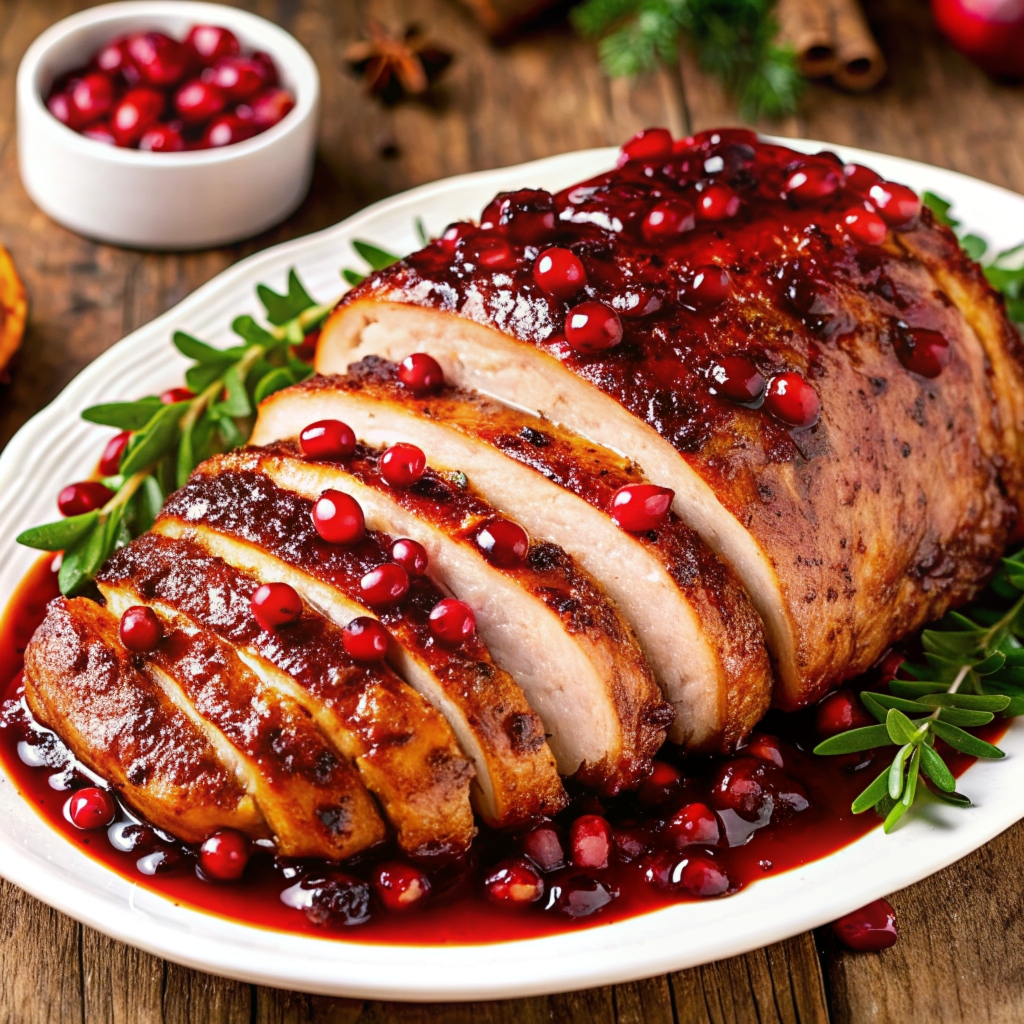
Juicy Pomegranate Glazed Turkey Breast is The best the kind of recipe that stops people mid-conversation the moment it lands on the table. That deep ruby-red glaze shimmering over perfectly roasted turkey, the aroma of pomegranate and warm spices filling the kitchen, the way the first slice reveals tender, impossibly moist meat underneath — it’s the sort of dish that earns you compliments before anyone has even taken a bite. If you’ve ever felt intimidated by cooking a whole turkey or found yourself stuck with dry, flavorless breast meat year after year, this recipe is going to change everything.
Pomegranate and turkey is a pairing that doesn’t get nearly enough attention in mainstream recipe culture. The natural tartness of pomegranate juice cuts beautifully through the richness of roasted turkey, while its natural sugars caramelize during roasting into a glossy, lacquered finish that looks like it came straight out of a professional kitchen. Add in a few aromatics, a touch of honey, and the right technique, and you have a dish that works equally well for Thanksgiving, Christmas, a Sunday dinner, or honestly any occasion where you want to make people feel genuinely taken care of.
This complete guide covers everything — from the full ingredient list and step-by-step instructions to pro tips, common mistakes, storage advice, nutrition information, and a detailed FAQ. Whether this is your first time cooking turkey breast or you’re looking to seriously upgrade your existing approach, read every section carefully. There’s something here for every level of cook.
Why Pomegranate Works So Well with Turkey
Before diving into the recipe itself, it’s worth understanding why this flavor combination is so effective. Turkey breast is lean by nature — it has less fat than the thigh or leg, which is exactly why it tends to dry out when cooked without care. A glaze does two important things: it adds a protective layer that helps lock in surface moisture, and it builds flavor from the outside in as the sugars reduce and intensify during roasting.
Pomegranate juice is naturally high in both sugar and acid, which gives it the perfect glaze-building profile. The acid tenderizes the surface of the meat slightly, the sugar caramelizes into that gorgeous deep-red lacquer, and t he complex fruity-tart flavor of pomegranate threads itself through every bite. When you balance the pomegranate with honey for sweetness, garlic for savoriness, and spices like cinnamon and allspice for warmth, you end up with a glaze that’s sophisticated without being fussy — and a turkey breast that tastes like you spent days preparing it, even though the hands-on time is minimal.
Ingredients
For the Turkey Breast
- 1 bone-in, skin-on turkey breast (approximately 5–7 lbs)
- 2 tablespoons olive oil
- 1½ teaspoons kosher salt
- 1 teaspoon freshly ground black pepper
- 1 teaspoon garlic powder
- 1 teaspoon onion powder
- ½ teaspoon smoked paprika
- ½ teaspoon ground cinnamon
- ¼ teaspoon ground allspice
- 4 garlic cloves, smashed
- 1 medium onion, roughly chopped
- 2 sprigs fresh rosemary
- 2 sprigs fresh thyme
- 1 cup chicken or turkey broth (for the roasting pan)
For the Pomegranate Glaze
- 2 cups pure pomegranate juice (not a blend or cocktail — 100% pomegranate)
- 3 tablespoons honey
- 2 tablespoons balsamic vinegar
- 2 garlic cloves, minced
- 1 teaspoon fresh thyme leaves
- ½ teaspoon ground cinnamon
- ¼ teaspoon ground black pepper
- Pinch of salt
- 1 tablespoon unsalted butter (stirred in at the end, off heat)
For Garnish (Optional but Beautiful)
- Fresh pomegranate arils
- Fresh rosemary sprigs
- Thin orange slices
- Microgreens or fresh thyme sprigs
Equipment Needed
- Large roasting pan with a rack
- Small saucepan
- Basting brush or spoon
- Meat thermometer (instant-read or leave-in probe style)
- Aluminum foil
- Kitchen twine (optional)

Step-by-Step Instructions
Step 1: Dry Brine the Turkey Breast (One Day Ahead — Strongly Recommended)
The single best thing you can do for a juicy turkey breast is dry brine it the night before. Mix together the kosher salt, pepper, garlic powder, onion powder, smoked paprika, cinnamon, and allspice. Pat the turkey breast completely dry with paper towels, then rub the spice mixture all over the bird — under the skin directly onto the meat, across the skin itself, and on all sides. Place it uncovered on a wire rack set over a baking sheet and refrigerate for at least 8 hours, ideally 24 hours.
This does two things simultaneously: the salt draws out a small amount of moisture initially, then gets reabsorbed back into the meat along with the flavors of the spices. The uncovered refrigeration also dries out the skin, which is essential for achieving that lacquered, slightly crisp exterior that contrasts so beautifully with the glaze.
If you’re short on time, even a 2-hour dry brine at room temperature will make a noticeable difference compared to seasoning immediately before cooking.
Step 2: Make the Pomegranate Glaze
While the turkey comes to room temperature (about 45–60 minutes before roasting), make your glaze. In a small saucepan over medium heat, combine the pomegranate juice, honey, balsamic vinegar, minced garlic, thyme, cinnamon, black pepper, and salt. Stir to combine and bring to a gentle boil. Reduce the heat to medium-low and let it simmer, stirring occasionally, for 20–25 minutes until the glaze has reduced by about half and coats the back of a spoon. It should look syrupy and glossy.
Remove from heat and stir in the tablespoon of butter — this adds a silky sheen and rounds out the flavor beautifully. Set aside. The glaze will thicken further as it cools. If it becomes too thick to brush, simply warm it gently over low heat before using.

Step 3: Prepare the Roasting Pan
Preheat your oven to 425°F (220°C). Scatter the smashed garlic cloves, chopped onion, rosemary, and thyme sprigs across the bottom of your roasting pan. Pour in the broth. Set a roasting rack over the aromatics — this elevates the turkey so air circulates underneath and it doesn’t steam in its own juices.
Step 4: Initial High-Heat Roast
Rub the turkey breast all over with olive oil, paying special attention to getting under the skin. Place it skin-side up on the roasting rack. Slide it into the preheated 425°F oven and roast uncovered for 20 minutes. This initial blast of high heat begins to set the skin and jump-starts the browning process.
Step 5: Reduce Heat and Begin Glazing
After the first 20 minutes, reduce the oven temperature to 325°F (165°C). Brush a generous layer of pomegranate glaze all over the exposed skin. Return to the oven and continue roasting, brushing with glaze every 20–25 minutes. Each layer of glaze builds on the last, creating that deep, burnished lacquer you’re aiming for.
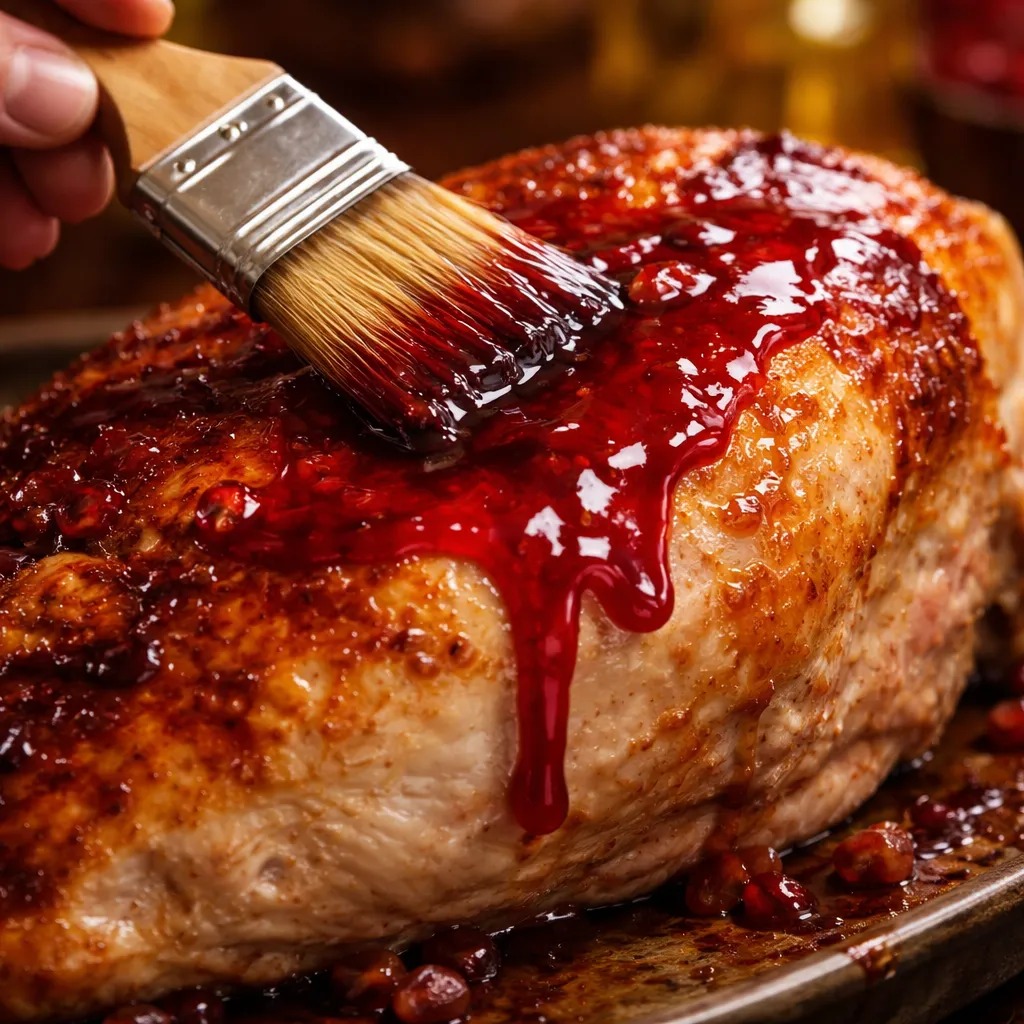
For a 5–6 lb turkey breast, total roasting time at this stage will be approximately 1 hour 15 minutes to 1 hour 30 minutes. A 6–7 lb breast may need up to 1 hour 45 minutes. Start checking the internal temperature at the 1-hour mark.
Step 6: Check for Doneness
The turkey breast is done when the thickest part of the meat (away from the bone) registers 160°F on an instant-read thermometer. Remove it from the oven at 160°F — it will carry over to 165°F (the USDA safe temperature) as it rests. If the skin is browning too quickly before the meat is done, tent loosely with foil for the last 20–30 minutes, then uncover and brush with one final coat of glaze before pulling it from the oven.
Step 7: Apply the Final Glaze and Rest
Once the turkey hits 160°F, brush it with one final generous layer of glaze and return it to the oven under the broiler for 2–3 minutes to caramelize that last coat into a glossy, deeply colored finish. Watch it carefully — the sugars in the glaze can go from beautifully caramelized to burnt very quickly under the broiler.
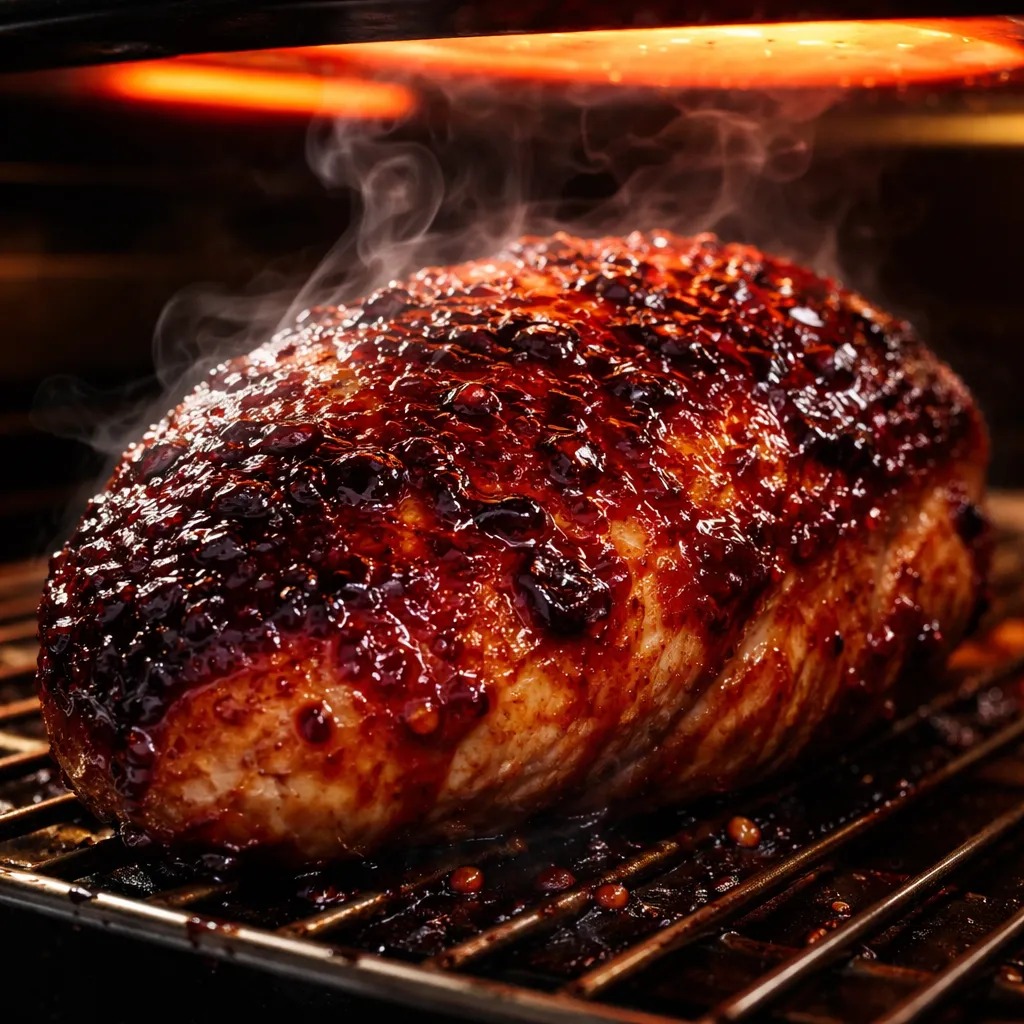
Remove from the oven and let the turkey breast rest on a cutting board, tented loosely with foil, for at least 20–30 minutes before carving. This resting period is not optional. It allows the juices to redistribute throughout the meat, ensuring every slice is as juicy as possible.
Step 8: Carve and Garnish
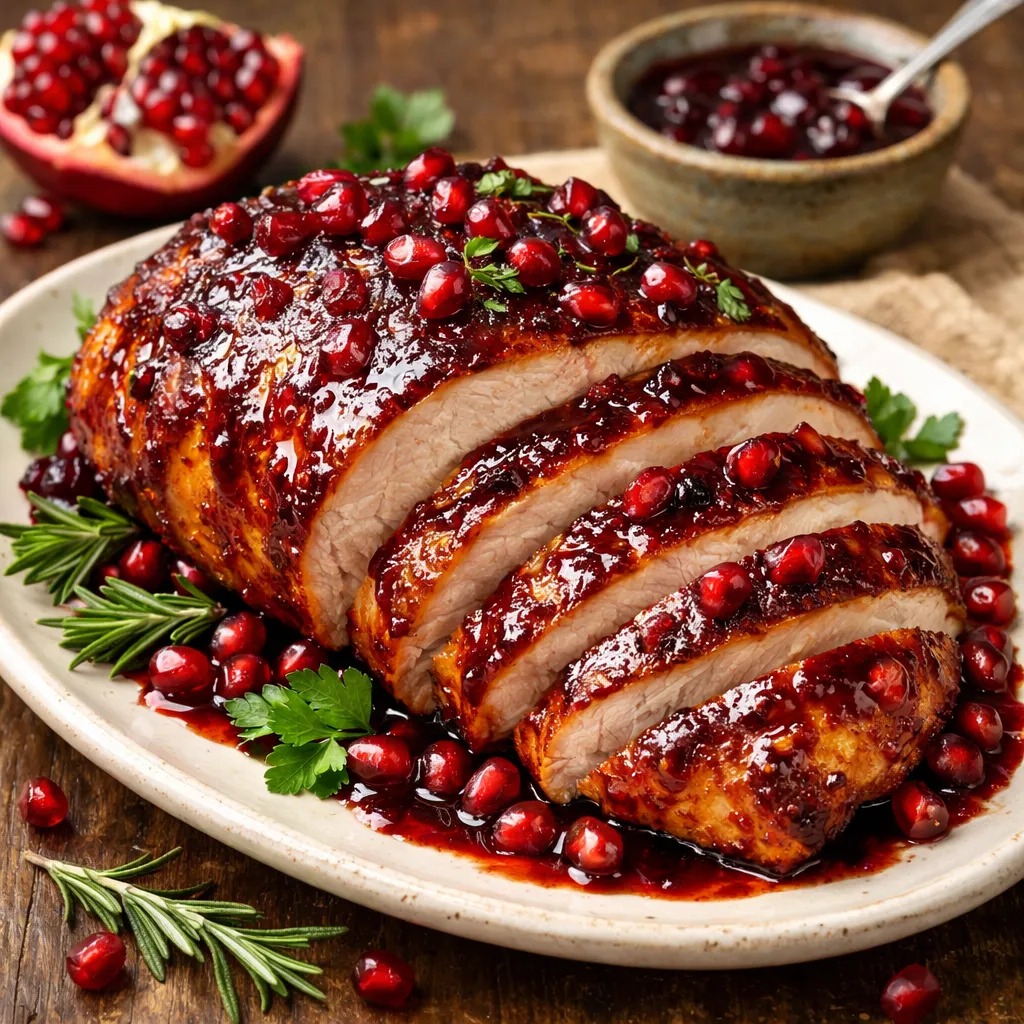
Carve the turkey breast by slicing downward alongside the breastbone, then cutting horizontally into neat, even slices. Arrange on your serving platter, drizzle with any remaining warm glaze, and garnish with fresh pomegranate arils, rosemary sprigs, and orange slices for a presentation that looks genuinely stunning.
Pro Tips for the Perfect Pomegranate Glazed Turkey Breast
Use 100% pure pomegranate juice. This is non-negotiable. Pomegranate cocktail blends or juice from concentrate simply don’t have the depth of flavor or the right sugar-acid balance to build a proper glaze. Look for bottles that list pomegranate as the only ingredient.
Don’t skip the dry brine. If there’s one step that separates a good turkey breast from an unforgettable one, it’s the dry brine. Season it the night before and leave it uncovered in the fridge. The difference in moisture, seasoning depth, and skin texture is remarkable.
Build your glaze in layers. Resist the urge to apply all the glaze at once. Multiple thin layers, applied every 20–25 minutes, build depth and complexity. Each coat caramelizes before the next goes on, creating that beautiful lacquered effect.
Use a leave-in probe thermometer if you have one. It eliminates the guesswork entirely. You can monitor the internal temperature from outside the oven without repeatedly opening the door and losing heat.
Let the glaze reduce properly. A thin glaze will run off the turkey and pool in the pan rather than adhering to the skin. You want it syrupy enough to cling — if it slides off a spoon quickly, keep reducing.
Don’t carve too early. Twenty to thirty minutes of resting is the minimum for a turkey breast this size. Cutting into it any sooner is one of the most common reasons perfectly cooked turkey turns out dry on the plate.
Add citrus to the roasting pan. A halved orange or lemon tossed into the pan alongside the aromatics adds another layer of fragrance that perfumes the meat as it roasts.
Common Mistakes to Avoid
Using a frozen turkey breast that hasn’t fully thawed. A partially frozen breast cooks unevenly, leaving the exterior overcooked while the interior is still undercooked. Always thaw completely in the refrigerator — allow 24 hours of thaw time for every 4–5 lbs of turkey.
Roasting at a single low temperature the whole time. Without that initial high-heat blast, you miss the opportunity to properly set and begin crisping the skin. Always start at 425°F for the first 20 minutes.
Opening the oven too frequently. Every time you open the oven door, you lose approximately 25–50°F of heat and extend your cooking time. Only open to apply glaze, and do it quickly.
Not checking the temperature before the estimated time is up. Oven temperatures vary, and turkey breast sizes vary. A recipe’s timing is always an estimate. Start checking about 15–20 minutes before the suggested time is up.
Applying cold glaze to a hot turkey. If your glaze has been sitting and thickened significantly, warm it gently before brushing it on. Cold glaze applied to hot turkey can shock the surface and create an uneven coating.
Skipping the resting period because guests are waiting. We understand the pressure of a dinner table full of hungry people, but cutting corners on the rest is almost always something you’ll regret. The turkey will stay warm under a foil tent for up to 30 minutes. Use that time to finish your sides.
Using a roasting pan without a rack. Without a rack, the turkey sits in its own juices and essentially steams from the bottom up. The skin on the underside will be soft and pale, and the texture throughout will be uneven. Always use a rack.
Storage and Serving Suggestions
How to Store Leftovers
Carved turkey breast keeps well in the refrigerator for up to 4 days in an airtight container. Store it with a spoonful of the pan drippings or a little extra broth to keep the meat moist. The pomegranate glaze can be stored separately in a sealed jar in the fridge for up to a week and gently rewarmed before serving.
For longer storage, freeze carved turkey breast in individual portions wrapped tightly in plastic wrap, then placed in freezer bags. It will keep for up to 3 months. Thaw overnight in the refrigerator before reheating.
How to Reheat Without Drying Out
Place sliced turkey in a baking dish, add a few tablespoons of broth or drippings, cover tightly with foil, and warm at 325°F for 15–20 minutes. The covered environment creates a gentle steam that keeps the meat moist. Brush with a little rewarmed glaze before serving to revive that gorgeous finish.
Serving Suggestions
This Juicy Pomegranate Glazed Turkey Breast is versatile enough to anchor a wide variety of menus. For a classic holiday spread, serve it alongside roasted sweet potatoes, herb stuffing, cranberry sauce, and roasted Brussels sprouts. The pomegranate glaze creates a natural bridge between savory and sweet components on the plate.
For a more elegant dinner party presentation, pair it with wild rice pilaf, roasted beets, a shaved fennel salad, and a glass of Pinot Noir — the earthy, slightly sweet notes in the wine mirror the pomegranate beautifully. Leftover slices work wonderfully in grain bowls, piled onto sourdough with arugula and a smear of whole-grain mustard, or chopped into a salad with feta, walnuts, and a citrus vinaigrette.
Frequently Asked Questions (FAQ)
Q1: Can I use boneless turkey breast for this recipe? Yes, absolutely. A boneless turkey breast will cook faster — typically 15–25 minutes less than a bone-in breast of comparable weight. The bone-in version does produce more flavor during roasting (the bone conducts heat and releases gelatin into the surrounding meat), but a boneless breast is perfectly delicious and a little easier to carve. Follow the same glazing technique and check the temperature earlier.
Q2: Can I make the pomegranate glaze ahead of time? Yes, and it’s actually a great idea. The glaze can be made up to 3 days in advance and stored in a sealed jar in the refrigerator. When you’re ready to use it, warm it gently in a small saucepan over low heat, stirring until it’s smooth and brushable again. Making it ahead of time removes one task from your cooking-day to-do list.
Q3: What if I can’t find 100% pomegranate juice? If pure pomegranate juice isn’t available at your local store, look for it at health food stores or online. In a pinch, you can use pomegranate molasses diluted with water (about 3 tablespoons of molasses to 1¾ cups of water), though the flavor will be more concentrated and slightly less nuanced. Avoid using pomegranate juice cocktails or blends, as the added sugars and other juices will throw off the balance of the glaze.
Q4: How do I know when my pomegranate glaze has reduced enough? The glaze is ready when it has reduced by roughly half its original volume and coats the back of a spoon without immediately running off. You can also do the plate test — spoon a small amount onto a cold plate and tilt it. If it moves slowly and holds its shape, it’s ready. If it runs quickly and spreads thin, keep reducing. Remember it will thicken more as it cools.
Q5: Can this recipe be made in a slow cooker? You can cook the turkey breast in a slow cooker on low for 6–7 hours or high for 3–4 hours, and then apply the glaze and finish under the broiler for 5–7 minutes to caramelize it. However, you won’t get the same deep roasted flavor or the gorgeous skin development that comes from oven roasting. The slow cooker method is convenient but produces a different — and less visually dramatic — result.
Q6: Is this recipe suitable for people with dietary restrictions? The base recipe is naturally gluten-free and can be made dairy-free by omitting the butter from the glaze (substitute a neutral oil if desired). It is also halal-friendly when prepared with halal-certified turkey. It is not suitable for vegetarians or vegans. For lower-sodium needs, reduce or omit the added salt in the dry brine and glaze.
Q7: My glaze is burning before the turkey is cooked through. What do I do? This is a common issue and an easy fix. The high sugar content in pomegranate and honey means the glaze can darken quickly, especially in a hot oven. If the surface is browning faster than you’d like, tent the turkey loosely with foil and continue roasting. Remove the foil for the last 20 minutes and apply fresh glaze, finishing under the broiler for the final caramelized layer.
Nutrition Information (Approximate Values per Serving)
Based on approximately 6 oz of cooked turkey breast meat with glaze, bone-in preparation. Values are estimates and will vary based on exact portion size and preparation.
| Nutrient | Amount per Serving |
|---|---|
| Calories | 290–340 kcal |
| Total Fat | 8–11g |
| Saturated Fat | 2–3g |
| Cholesterol | 95–115mg |
| Sodium | 420–480mg |
| Total Carbohydrates | 18–22g |
| Dietary Fiber | 0g |
| Sugars | 15–18g (from pomegranate and honey) |
| Protein | 34–38g |
| Iron | 10% DV |
| Calcium | 3% DV |
| Potassium | 420mg |
| Vitamin C | 6% DV |
To reduce sugar content, cut the honey in the glaze by half and reduce the pomegranate juice to 1½ cups. This lowers the carbohydrate count by approximately 6–8g per serving.
Juicy Pomegranate Glazed Turkey Breast is more than a holiday recipe — it’s the kind of dish that turns an ordinary gathering into a genuine occasion. From the moment that deep ruby glaze starts caramelizing in the oven and the aroma of pomegranate, honey, and warm spices fills your kitchen, you’ll know you’ve made something worth being proud of.
What makes this recipe truly special is how it balances elegance with approachability. The technique isn’t complicated — it’s just intentional. Dry brine the night before, build the glaze in layers, respect the resting time, and the results will speak for themselves every single time. No guesswork, no stress, no dry turkey.
The pomegranate glaze does everything a great glaze should do — it adds color that stops people mid-sentence, a sweet-tart complexity that keeps every bite interesting, and a glossy finish that photographs beautifully and tastes even better than it looks. Paired with tender, deeply seasoned meat that stays juicy all the way through, this is a turkey breast recipe that genuinely delivers on every promise it makes.
Whether this becomes your go-to Thanksgiving centerpiece, your Christmas dinner showstopper, or simply the recipe you pull out whenever you want to make people feel truly taken care of, it earns its place at the table every single time.
Cook it once — and it will be requested by name for years to come.

Juicy Pomegranate Glazed Turkey Breast
Ingredients
Equipment
Method
- Mix together kosher salt, black pepper, garlic powder, onion powder, smoked paprika, cinnamon, and allspice. Pat the turkey breast completely dry with paper towels. Rub the spice mixture all over the turkey — under the skin directly onto the meat, across the skin, and on all sides. Place uncovered on a wire rack set over a baking sheet and refrigerate for at least 8 hours, ideally 24 hours.
- Remove the turkey breast from the refrigerator 45–60 minutes before roasting to come closer to room temperature. In a small saucepan over medium heat, combine pomegranate juice, honey, balsamic vinegar, minced garlic, thyme, cinnamon, black pepper, and salt. Bring to a gentle boil, then reduce heat to medium-low. Simmer for 20–25 minutes, stirring occasionally, until reduced by half and syrupy. Remove from heat and stir in the butter. Set aside.
- Preheat oven to 425°F (220°C). Scatter smashed garlic, chopped onion, rosemary, and thyme across the bottom of the roasting pan. Pour in the broth. Set a roasting rack over the aromatics.
- Rub the turkey breast all over with olive oil, including under the skin. Place skin-side up on the roasting rack. Roast uncovered at 425°F for 20 minutes to set and begin browning the skin.
- Reduce oven temperature to 325°F (165°C). Brush a generous layer of pomegranate glaze all over the skin. Return to oven and continue roasting, brushing with glaze every 20–25 minutes, building up layers of lacquer. Total roasting time at this stage is approximately 1 hour 15 minutes to 1 hour 45 minutes depending on size. Begin checking internal temperature at the 1-hour mark.
- Insert an instant-read thermometer into the thickest part of the breast, away from the bone. The turkey is ready to come out of the oven when it reads 160°F. If the skin is browning too quickly, tent loosely with foil for the last 20–30 minutes, then uncover before the final glaze application.
- Brush one final generous layer of glaze over the turkey and switch the oven to broil. Broil for 2–3 minutes, watching carefully, until the glaze caramelizes into a deep, glossy, lacquered finish. Remove immediately from the oven.
- Transfer turkey breast to a cutting board and tent loosely with aluminum foil. Let rest for 20–30 minutes before carving. This allows juices to redistribute throughout the meat for maximum juiciness.
- Carve the turkey by slicing downward alongside the breastbone, then cutting into even slices. Arrange on a serving platter, drizzle with remaining warm glaze, and garnish with fresh pomegranate arils, rosemary sprigs, and orange slices. Serve immediately.


